If you spend any time around Ayurveda you will hear this word constantly. Ama explains the coating on your tongue, the heaviness after lunch, the fog you have stopped noticing and the achiness in the joints. It is the reason we cleanse in autumn. It is the reason I ask about your digestion before I ask about almost anything else.
I'd like to explain it in the plainest terms in order to help you understand what it really means to you and why you want to pay attention to it.
First, the fire

You cannot understand ama without understanding agni — the digestive fire. Agni is the whole capacity of the body to break things down, take what is useful, and let the rest go. Every single tissue has its own agni. The one in the gut is simply the first and most obvious and it is the foundation of health and also, the area of focus during Ayurvedic cleanse.
When agni is strong, food becomes you. It is broken down completely, absorbed cleanly, and what remains leaves without fuss. Healthy agni leaves you feeling light after eating and hungry again at the right time.
When agni is weak, the transformation process of digestion simply does not work well. And this is true for the digestion of food but also applies to the digestion of emotion, experience and information.
So, what is ama?
Ama is what is left when digestion cannot finish its work. Undigested toxic waste — sticky, heavy, cold, and sour. Think of a fire given wood that is too wet or too plentiful: instead of clean heat you get smoke and unburnt material, and the fire itself grows weaker under the weight of what it could not consume.
And ama does not simply sit there. It actually further dampens the very fire that would have cleared it, so a little becomes more, and more becomes a pattern. And the pattern becomes the issue.
Ama is not only about food
This is the part people find surprising, and it is the part I find most useful.
Ayurveda does not restrict digestion to the stomach. We digest experience, emotion, conversation, season, sensation — everything we take in. A grief that was never allowed to move through you is undigested in exactly the same sense as a meal eaten standing over the sink at eleven at night.
Which is why how you eat matters as much as what you eat, and why a beautifully composed meal taken in a rush, in traffic, or in the middle of an argument can still leave residue behind. The state you are in becomes part of the meal.
How you would recognize Ama
Ama is heavy, sticky and dull, and it announces itself in those qualities. Classically we look for:
- A coating on the tongue in the morning — the clearest sign, and the one you can see yourself
- Heaviness or sleepiness after eating, rather than steadiness
- Dull appetite, or appetite that has lost its rhythm
- A thick, slow, foggy quality to the mind
- Sluggish or irregular elimination
- Bad breath, a sticky mouth, a dulled sense of taste
- Aching that moves, and a general sense of heaviness in the body
If you want to learn to read the first one properly, I wrote a whole piece on it: what your tongue is telling you.
What clears Ama
The logic is simple once you see it. Ama is heavy, cold, damp and dull — so what clears it is light, warm, dry and stimulating.
Warmth. Warm, freshly cooked food. Warm water through the day (rather than iced, which is constricting). Very little that is cold, raw or straight from the refrigerator.
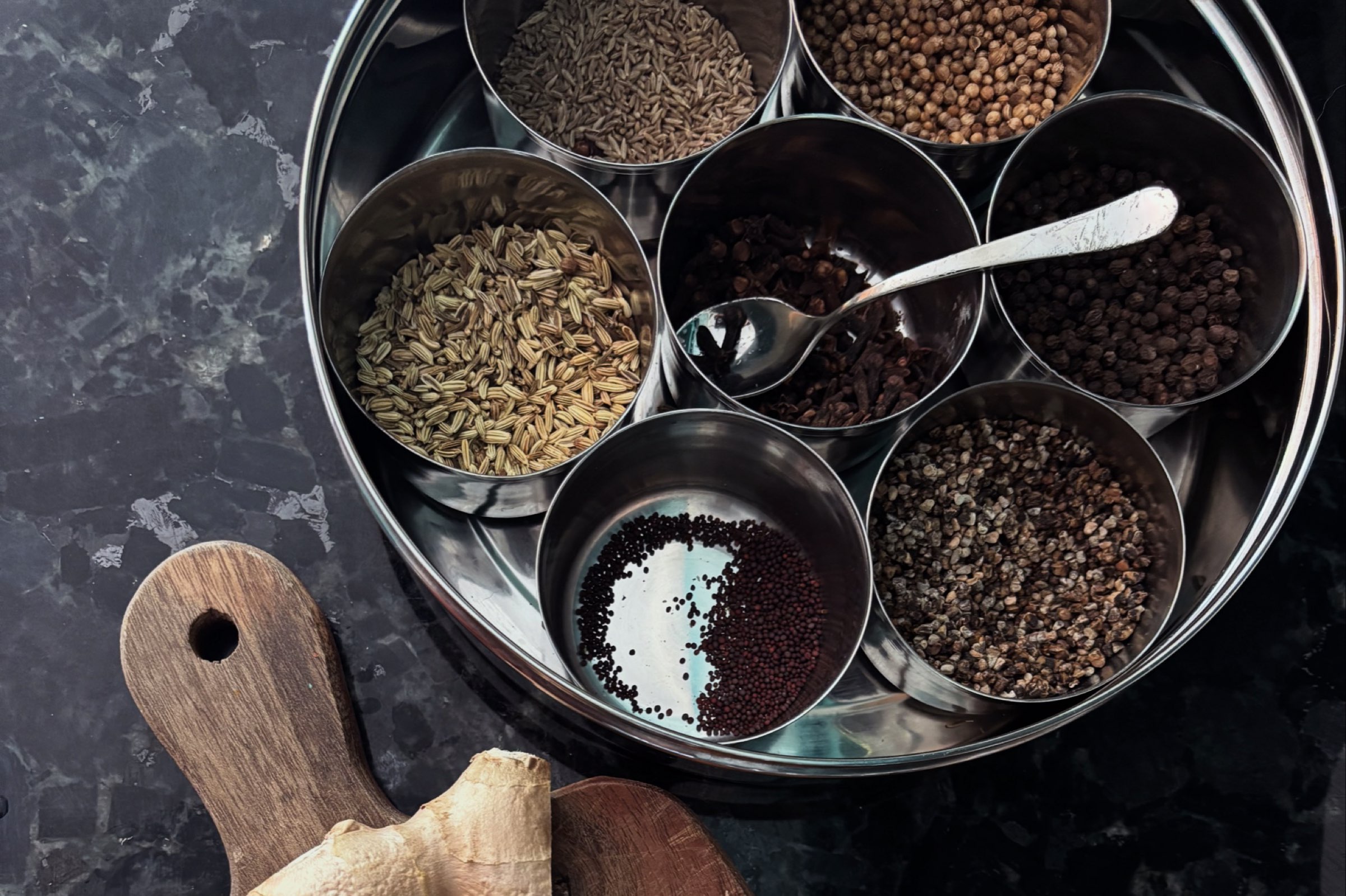
Spice. Ginger, black pepper, cumin, coriander & fennel. These are not simply flavoring — in Ayurveda they are the everyday medicine that keeps agni burning cleanly. A little fresh ginger before a meal is a foundational medicinal practice with immense benefits.
Simplicity. Fewer ingredients that are well combined. Complicated meals ask more of the fire than simple ones. This is also why food combining matters — two wholesome foods that digest at different rates can leave residue that neither would alone.
Space. Leaving real gaps between meals, so digestion can finish before it is asked to start again. Constant grazing never lets the fire come back up. Allowing 3–4 hours between meals is powerful for avoiding the build up of ama.
Rhythm. Eating, sleeping and rising at consistent times. Agni follows the day; when your habits contradict it, agni loses its shape. This is the whole argument for dinacharya.
Most of what clears ama is ordinary and free. You do not necessarily need a supplement or a practitioner to begin — you need warm food, a few spices, and gaps between meals. Start there!
But, sometimes the ordinary is not enough
Sometimes ama has been accumulating for years, and daily habits will keep it in check without ever quite clearing it. That is what a seasonal cleanse is for — a deliberate window in which the diet is simplified, agni is rekindled, and what has gathered is loosened and given a way out.
Autumn is one of the two natural windows for this. The Autumn Community Detox runs November 5–14. This cleanse invites you (with my help) to support the natural process of releasing ama, leading to greater vitality. If you are wondering whether it is the right season for you, I wrote about how I help people decide: are you ready to cleanse?
And if any of this raised a question about your own digestion, write to me. I value the chance to explore this together and am happy to address your personal questions.
This writing is educational and reflects traditional Ayurvedic practice. Ama is a concept within Ayurveda's own framework, not a medical diagnosis, and nothing here is a substitute for care from your physician. If you are pregnant, nursing, managing a health condition, or taking medication, please speak with your doctor before changing your diet or beginning new practices.
Om Shanti,
Brit